Updated: November 22, 2026 | Author: Manas Panda
China Digital Marketing Trends 2026: What Is Trending, Where, and What Is Coming Next
AI search, live commerce, private domain, guochao and lower-tier cities are rewriting how brands win in China. Here is what the data actually says — and what to do about it.
- Discovery has moved to AI and short video. 602 million people in China used generative AI by December 2025, up 141.7% in a year. Brands now need to be cited by DeepSeek, Doubao and Qwen — not just rank on Baidu.
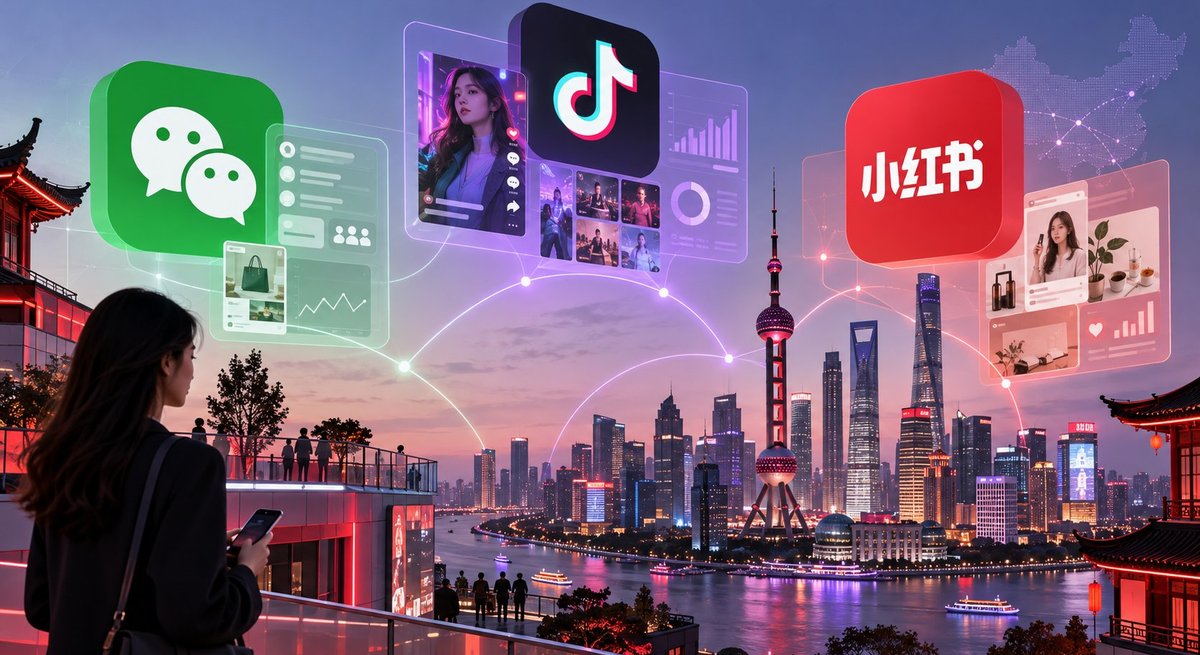
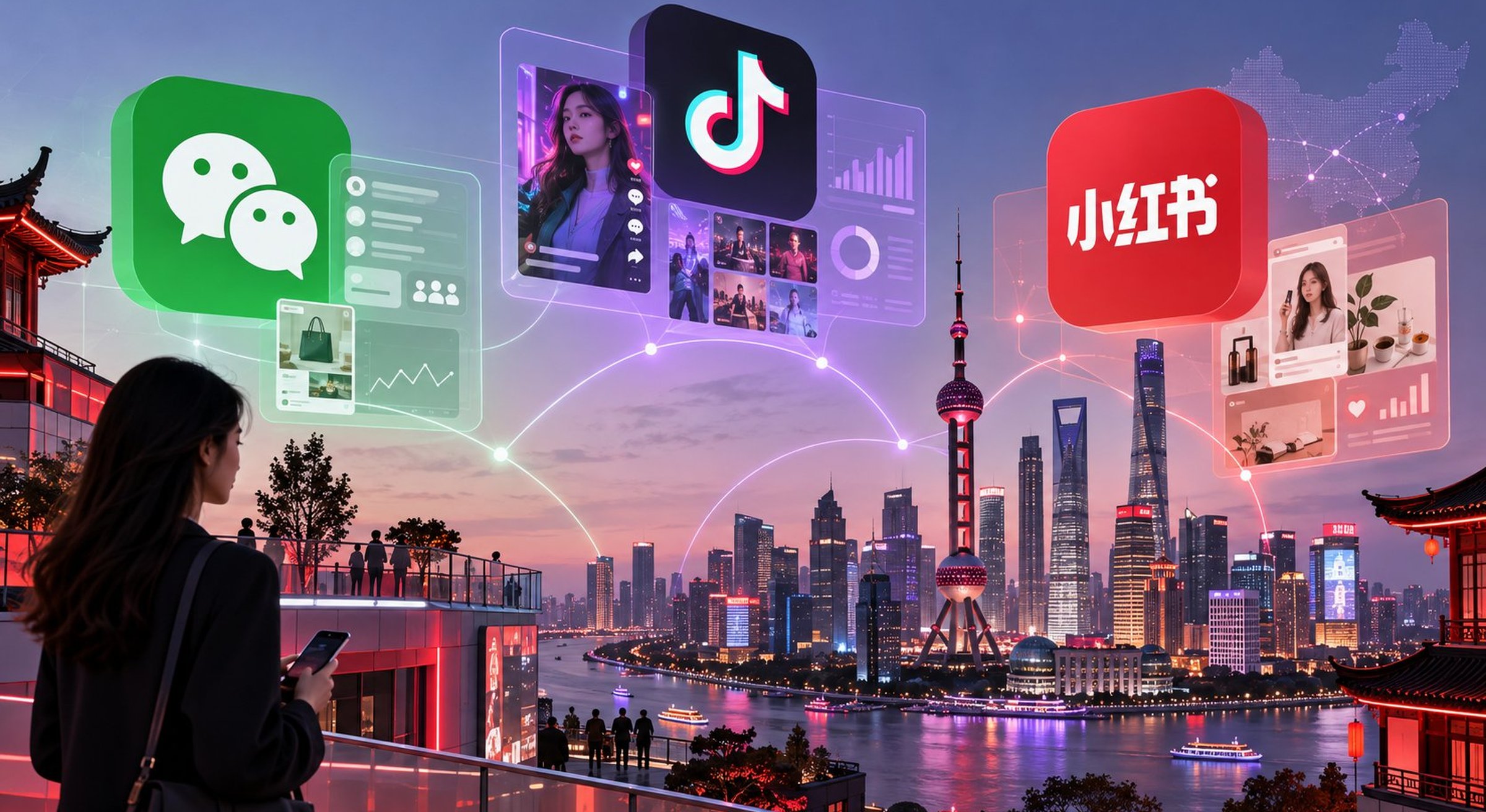
- Douyin, Xiaohongshu and WeChat work as a system. Douyin discovers, Xiaohongshu validates, WeChat retains and sells. Using only one is like running ads with no shop.
- Live commerce is mature, not new. It passed ¥6 trillion in 2025. The winners in 2026 run store-led live rooms, use AI hosts carefully, and comply with the new February 2026 livestream law.
- The growth is no longer only in Shanghai and Beijing. Tier 3, tier 4 and rural consumers are outgrowing tier 1 on several measures, and Kuaishou and Pinduoduo were built for them.
- Trust beats reach. KOC reviews, ingredient transparency and private domain communities convert better than one big KOL post. 61.49% of consumers say KOL/KOC reviews are their main source of product recommendations.
Let me be honest about something first. If your China plan still looks like “translate the website, buy some Baidu ads, maybe post on Weibo,” you are not just behind — you are invisible. Google, Facebook, YouTube and X are blocked in mainland China, so the Western playbook does not travel. What replaces it is a closed, mobile-first ecosystem where search, social, video, payment and shopping live inside a handful of super-apps.
That sounds intimidating. It is, a little. But it is also clearer than it looks once you see the pattern: people discover on video and AI, they check on Xiaohongshu and WeChat, and they buy inside the app. Everything in this article hangs off that sentence.
- 1. The 2026 snapshot in numbers
- 2. What has actually changed since 2023
- 3. Platform by platform: where to show up
- 4. Niche by niche: where the money is moving
- 5. Location by location: tier 1, tier 2, tier 3–4 and rural
- 6. The new search: SEO + GEO + WeChat search + Xiaohongshu search
- 7. Live commerce in 2026: what works now
- 8. KOL vs KOC vs private domain: how to split the budget
- 9. Guochao and Gen Z: how foreign brands survive
- 10. Compliance: the rules that now shape marketing
- 11. What is coming next in 2026–2027
- 12. A practical 90-day plan
- 13. FAQ: China digital marketing in 2026
- Chinese search terms this guide covers
- Sources
1. The 2026 snapshot in numbers
China had 1.125 billion internet users at the end of 2025, an 80.1% penetration rate, and 99.4% of them go online on mobile, according to CNNIC's 57th Statistical Report on China's Internet Development (February 2026). In other words, if your site or store is not fast and clean on a phone, you have lost most of the country before you start.
| Signal | 2026 figure | Source |
|---|---|---|
| Internet users | 1.125 billion, 80.1% penetration | CNNIC, Feb 2026 |
| Generative AI users | 602 million by Dec 2025, +141.7% YoY; 42.8% of population used gen AI in past 6 months | CNNIC 57th Report |
| Online shoppers | 83.2% of internet users (937 million); online physical goods = 26.1% of retail sales | CNNIC 57th Report |
| Online payment | 90.3% of internet users (1.017 billion) | CNNIC 57th Report |
| Short video users | 1.074 billion, 95.4% of internet users | DataReportal Digital 2026: China |
| Live streaming users | 813.59 million, 72.3% of internet users | CNNIC, Dec 2025 |
| Digital ad spend | ~US$163.1 billion in 2026, growing ~15.7% YoY | Research and Markets / GlobeNewswire, Jan–Feb 2026 |
| Marketing budgets | Up ~10% on average in 2026 | 2026 China Digital Marketing Trends Report |
| Rural internet users | 314 million, 27.9% of total; rural penetration 69.5%, +2.2 points YoY | CNNIC, Dec 2025 |
A note on numbers: different firms measure e-commerce and ad spend differently, so you will see ranges. Where estimates conflict, I say so. The direction, though, is consistent across every major source — mobile-first, AI-driven, video-led, and shifting inland.
2. What has actually changed since 2023
Five shifts matter more than all the tactics.
From keyword search to AI answers
People used to type “best laptop” into Baidu and compare blue links. Now they ask DeepSeek or Doubao, “Which laptop is best for video editing under ¥8,000?” and act on the synthesized answer. QuestMobile counted 446 million monthly users of AI-native apps in March 2026 — Doubao alone at 345 million, with 54.8 sessions per user per month, followed by Qwen at 166 million and DeepSeek at 127 million. If your brand is not in those answers, you were eliminated before the consideration stage.
From renting traffic to owning it
Public ad costs keep rising, so brands are pulling customers into WeChat — Official Accounts, Mini Programs, Enterprise WeChat and groups. Marketers call this siyuliu (私域流量), private domain traffic. It is slower to build and far cheaper to keep.
From mega-KOLs to KOCs
According to iiMedia Research, 61.49% of Chinese consumers say KOL and KOC review videos are their main source of product recommendations in 2026 — ahead of brand-owned content. KOCs (Key Opinion Consumers, everyday users with small engaged followings) typically get 5–15% engagement versus 1–3% for large KOLs, at a fraction of the cost.
From tier 1 prestige to tier 3–4 volume
Bain's China Shopper Report found FMCG sales volume in Q3 2024 rose +2.9% in tier 3 and +5.5% in tier 4 cities while tier 1 fell 4.4%. Online growth in tier 4 was +10.5% versus +2.3% for the market overall. The map of growth has moved.
From polished ads to provable claims
Consumers check ingredient lists, cross-check influencer claims on two or three apps, and punish anything that feels hidden. The February 2026 livestream measures made that legal, not just cultural: false claims now carry shared liability for brand, host and platform.
| Old playbook | 2026 reality |
|---|---|
| Baidu SEO only | GEO + Baidu SEO + WeChat search + Xiaohongshu search |
| One mega-KOL post | 50 KOC seeds + a few mid-tier KOLs for reach |
| One-off campaigns | Always-on content system + store-led live rooms |
| Buy public traffic | Build private domain on WeChat |
| Target Shanghai/Beijing only | Tier 3+ is the growth frontier |
| Website as the hub | Mini Program inside WeChat as the hub |
3. Platform by platform: where to show up
| Platform | Scale (2026) | Best for | Watch out |
|---|---|---|---|
| WeChat / Weixin (微信) | 1.439 billion MAU, Q2 2026 (Tencent) | CRM, Official Account, Mini Program shop, private groups, retention | Closed ecosystem — no outside links, slow to build |
| Douyin (抖音) | ~1.03 billion MAU, H1 2026 (QuestMobile, third-party) | Short video, livestream sales, discovery, paid reach | Crowded, auction costs high in tier 1 |
| Xiaohongshu / RED (小红书) | 350 million+ MAU reported; 400M+ cited in 2026 platform coverage | Reviews, product discovery, beauty, fashion, travel — “seed planting” | Female, urban skew; needs authentic notes, not ads |
| Kuaishou (快手) | 797.3M MAU, 412.3M DAU, Q2 2026 (company results) | Lower-tier cities, livestream commerce, loyal host communities | Lower average basket than Douyin, though rising |
| Bilibili (B站) | 376M+ MAU in 2026 | Explaining complex products, younger male audience, less saturated feed | Community culture — hard sell content gets rejected |
| Baidu (百度) | 70%+ search share in most estimates | Verification, high-intent search, AI assistant (Wenxin) | Declining share of discovery vs AI and social |
| Tmall / JD / Pinduoduo | Marketplaces, not social apps | Transaction, fulfilment, search-based buying | Discovery is moving off-marketplace to Douyin/Xiaohongshu |
WeChat Channels (视频号) deserves a special mention. Buried in WeChat's Discover tab at launch, it now draws an estimated 620–680 million daily users through 2026 — ahead of Douyin's daily users on raw scale — with watch time up over 20% year on year. For B2B brands especially, Channels plus an Official Account is where engineers and procurement managers actually research suppliers. Zhihu, China's Quora, plays a similar role for technical credibility.
4. Niche by niche: where the money is moving
Beauty and skincare
Still the most Xiaohongshu-native category. The platform's 2026 Beauty Emotion White Paper (200,000+ notes analysed) found consumers now buy on “what fits me,” not just “what works” — scenario-based, identity-driven content converts, generic demos do not. Beauty is also a top cross-border category at roughly 27% of CBEC imports, led by Japan, Korea, France and the US.
Food, beverage and coffee
China's coffee market is worth around US$5.8 billion in 2026, but the interesting story is guochao coffee — Chinese-style flavours like lotus seed milk lattes and goji berry cappuccinos, driven by Gen Z. Premium food with a verified origin story (French cheese, Australian wine, Japanese wagyu) commands a real price premium among urban 28–45s. Douyin livestream is now a primary discovery channel for imported food.
Pet products — the fastest-growing CBEC niche
Pet products are expanding at +20–25% year on year on Tmall Global, the highest growth rate of any cross-border import category, in a market worth about ¥312 billion. This is not a one-platform or one-city trend.
Health supplements and mother & baby
Health supplements grow at +18–22% YoY on Tmall Global — second fastest — and CBEC now accounts for roughly 50% of all health supplement e-commerce sales in China, up from 43% in 2022. Mother & baby ranks #3 by GMV with +10–14% growth, driven by one overriding priority: safety and certification.
Collectibles, toys and the guzi economy
Domestic retail sales of trendy and collectible toys hit ¥67.69 billion in 2025, up 45.4%, according to the 2026 China Toy and Juvenile Products Industry Development Report. Gen Z treats game and anime IP the way older generations treated football clubs — a shared identity worth paying a premium for. Domestic hits like Black Myth: Wukong and Ne Zha gave young consumers homegrown IP to rally around.
Sports, outdoor and travel
During the 2026 Spring Festival, gaming, travel and outdoor products saw their fastest-ever growth on Tmall, driven by under-35s. Xiaohongshu travel guides have a long tail — a good note can drive booking intent for 12 to 24 months.
The silver economy — the niche everyone underestimates
China had 320–323 million people aged 60+ at the end of 2025, about 23% of the population. Estimates of the silver economy market vary by definition — around ¥7 trillion (HKTDC) to ¥9.8 trillion in 2026 (China Business Industry Research Institute) — but the direction is unmistakable. Middle-class seniors spend on average over ¥7,000 a month, prioritise leisure and happiness (65%), value for money (63%) and practicality (62%). They are on WeChat (51+ is ~23% of its base), they watch short video, and the fastest-growing audience on Douyin and Kuaishou is now people over 60. Health products, travel, smart home, eldercare services and cultural entertainment are the entry points. Do not assume older consumers only hunt the lowest price — a quality-focused minority accounts for roughly three-quarters of older consumers' online spending.
B2B and industrial
Yes, Douyin works for industrial companies. Short, authentic videos have become a proven lead-generation engine for technical and manufacturing firms, and WeChat Channels plus Zhihu build the long-term trust Chinese buyers demand before they ever fill in a form.
5. Location by location: tier 1, tier 2, tier 3–4 and rural
Tier 1 — Shanghai, Beijing, Guangzhou, Shenzhen
High purchasing power, high ad costs. A single Douyin TopView placement in tier 1 can exceed ¥1 million. Consumers here are the most sophisticated: they demand ingredient transparency, clinical evidence and authentic brand narratives over flashy logos. Xiaohongshu is strongest here for luxury, beauty and lifestyle. Win on authority and AI search visibility, not volume.
Tier 2 — Chengdu, Hangzhou, Wuhan, Xi'an, Chongqing, Suzhou
The fastest-growing middle class. Strong Douyin and WeChat adoption, balanced practicality and aspiration. This is where value-for-money plus emotional connection wins, and where many brands now find their best ROI.
Tier 3 and tier 4 — the real growth engine
More than 60% of new live-stream buyers now come from tier 3 and smaller cities. Kuaishou reports about 60% of its users are tier 3 and below, with 22.6% aged 51+. Bain found warehouse club formats grew +59% year-to-date in tier 3/4 cities versus +11% in tier 1/2. Starbucks, after a 14% sales drop in big cities in 2024, refocused expansion on tier 3 and 4. Lower rents, less competition, faster store profitability — and digital purchasing power approaching tier 1 because living costs are lower.
Rural China
314 million rural internet users, penetration up to 69.5%. Rural online retail grew from ¥353 billion in 2015 to ¥2.56 trillion in 2024, with live streaming among the new formats driving rural businesses. Rural consumption is growing at 6–7% year on year, outpacing urban growth of 4–5%.
6. The new search: SEO + GEO + WeChat search + Xiaohongshu search
This is the section most foreign brands get wrong, so let me slow down.
Traditional China SEO means ranking on Baidu. It still matters for verification and high-intent queries, but it is no longer the front door.
GEO (Generative Engine Optimization) means getting your brand cited inside AI answers from Doubao, DeepSeek, Qwen, Kimi, Yuanbao and Baidu's Wenxin Assistant. The mechanics are different from SEO:
- Chinese LLMs cite Chinese platforms heavily — WeChat Official Accounts, Douyin, Xiaohongshu, Baidu ecosystem — not Wikipedia and Reddit like Western models.
- Structured content wins: product specs, comparison tables, FAQ formats and step-by-step guides get cited far more than promotional blog posts.
- Third-party evaluations now account for about 80.9% of sources in AI answers in recent tests. Objective, verifiable data beats brand self-description.
- One engine is not enough. In Phoenix New Media tests, the same brand (lululemon) was mentioned in 71% of Qwen answers, 66% of Doubao answers and 70% of DeepSeek answers. Optimising for a single engine abandons a third of AI search traffic.
- Doubao's trust algorithm reportedly requires core facts to be confirmed by at least three independent authoritative sources. One press release will not do it.
WeChat search and Xiaohongshu search are the other two front doors. Xiaohongshu notes stay indexed and searchable for months — that is why KOC seeding compounds. A kitchenware brand entering via cross-border e-commerce moved 70% of its influencer budget to 55 KOC accounts on Xiaohongshu; within eight weeks it had 210 organic notes live, a 4.1% average save rate, and a 34% increase in store visits from Xiaohongshu search, at roughly one-third of the original KOL spend. The KOL posts had better single-day views. The KOC batch kept converting for weeks.
What to do: build one unified brand fact base (specs, prices, certifications, origin, FAQs in Simplified Chinese), publish it as structured pages with FAQ and table formats, seed it across WeChat, Douyin and Xiaohongshu, earn third-party mentions, and audit monthly — ask your core brand terms in Doubao, Qwen, DeepSeek and Yuanbao and record mention rates.
7. Live commerce in 2026: what works now
Live streaming e-commerce passed ¥6 trillion in 2025, growing about 20% year on year — slower than the 45% growth years, which tells you it is maturing, not dying. Douyin e-commerce GMV was estimated at about US$568 billion in 2025, growing roughly 45% year on year, with live streaming driving about 65% of transactions in H1 2026. For international brands tracked across Tmall, JD and Douyin, Douyin Shop generated 28% of GMV in Q1 2026, up from 19% a year earlier, with livestream conversion at 4.8% — the highest of any format.
Three things have changed in how live commerce works:
- Store-led beats influencer-led. On Taobao Live, over half of GMV now comes from store-run live rooms. On Douyin, brand-led streams overtook influencer sessions in 2024 at 41% of GMV. Brands are building their own rooms instead of renting KOLs per session.
- AI hosts are real, and now regulated. Brands report saving around ¥150,000 a month in labour costs with AI digital humans, with overnight GMV up 200% in some cases. But the February 2026 measures require AI streamers to be clearly labelled.
- Localised content is a 2.6× multiplier. International brands investing in Chinese voiceovers, local KOLs and culturally relevant scripts achieved 2.6× the revenue of brands repurposing Western creative. Repurposed English ads lag 60–70% behind.
One warning from the data: customer acquisition cost for small and medium merchants on Douyin e-commerce hit ¥38 per person in Q1 2026, up 89% year on year. The platform's headline GMV growth is partly fuelled by small merchants. Live commerce rewards content discipline — daily livestream, weekly creative refresh, constant short video. Without that discipline, you burn money.
8. KOL vs KOC vs private domain: how to split the budget
| KOL (Key Opinion Leader) | KOC (Key Opinion Consumer) | |
|---|---|---|
| Followers | 100,000 – millions | 1,000 – 100,000 |
| Engagement | 1–3% | 5–15% |
| Cost per post | ¥10,000 – ¥10,000,000+ | ¥200 – ¥5,000 or gifted product |
| Primary value | Awareness and reach | Trust and purchase conversion |
| Content longevity | 24–72 hour peak | Searchable for months |
China's influencer marketing economy is forecast at about ¥117.2 billion in 2026, with growth concentrated in the KOC segment, not celebrity deals. The simplest way to think about it: KOLs create aspiration, KOCs create validation. The brands that win use both — a few KOLs for launch moments, a steady drumbeat of KOC seeds for search and social proof, and WeChat private domain to keep the customers those posts win.
On the public-to-private funnel (公域转私域): run paid ads on WeChat Moments or Channels optimised not for immediate clicks but for friend-add rates — the share of viewers who follow your Official Account or add your Enterprise WeChat. A sustained add rate above 30% correlates with long-term ROI improvement, and each added contact can represent ¥300–1,500 in lifetime value.
9. Guochao and Gen Z: how foreign brands survive
Guochao (国潮, “national trend”) is the shift where young Chinese consumers actively prefer brands carrying Chinese cultural identity, design or ownership. China's Gen Z counts more than 260 million people and already drives around 40% of total consumption, according to recent guochao consumer research. iiMedia Research projects the broader guochao market will exceed ¥3 trillion by 2028.
Here is the part foreign brands misread: guochao pride does not mean Gen Z rejects you. It means they judge you by the same bar they now hold domestic brands to. Around 72% of guochao-driven consumers want ingredient and material information made public. Over half of young people surveyed say they choose heritage Chinese brands because they genuinely value Chinese culture and trust homegrown names — not because a foreign brand is unavailable.
“Consumers today want more emotional resonance and cultural identity in their spending.” — Xiong Haifeng, Communication University of China, on the guochao shift
What that means in practice: your Chinese content needs to answer questions before they get asked. Where does the material come from? How was it tested? Why does it cost what it costs? A polished ad with no substance behind it reads as exactly what it is to this audience. Loyalty used to be handed to a brand automatically. Now it is earned with checkable content.
For foreign brands, the playbook is not to imitate guochao — it is to be guochao-aware: localise taste and language, partner with Chinese creators, respect cultural IP, and prove quality with data instead of imported-label prestige. The premium foreign brands can command over domestic equivalents has already shrunk from 40–60% in 2019 to roughly 20–30% in 2026. You earn the rest.
10. Compliance: the rules that now shape marketing
Compliance in China is not a legal footnote. It is a competitive advantage, because the rules changed the economics of the whole channel.
| Framework | What it means for marketing |
|---|---|
| Livestream E-commerce Measures (Order No. 117), effective 1 Feb 2026 (SAMR + CAC) | First dedicated live commerce law. Livestream promotion is now explicitly advertising under the Advertising Law. Commercial live sessions must display the 广告 (advertisement) label. MCNs must register and disclose identity. Livestream recordings must be archived at least 3 years. AI digital human streamers must be labelled. Brand and host share liability for false claims. |
| Advertising Law of the PRC | Bans superlative terms like “best” or “No. 1” without proof. All claims must be truthful and substantiated. Fines of ¥100,000–2,000,000 depending on severity. |
| PIPL (Personal Information Protection Law) | Clear informed consent for data collection, data minimisation, and security assessment for cross-border data transfers. Fines up to 5% of annual revenue. |
| E-Commerce Law | Operator registration and licensing, transparent disclosure of commercial content — sponsored posts must be identified. |
| Anti-Unfair Competition Law | Prohibits false advertising and keyword hijacking, with extraterritorial reach — overseas acts harming Chinese market competition can be enforced. |
Your compliance checklist before spending a yuan: verify your MCN is registered; add the 广告 label to every live brief; update KOL/MCN contracts with a shared liability clause; audit your existing live session archive; train hosts on product quality, consumer rights and platform rules before their first stream and annually after; register trademarks in China under the first-to-file system.
11. What is coming next in 2026–2027
- Agentic AI shopping. Tmall is betting on agentic AI and high-value consumers — its AI customer support tool Dianxiaomi boosted conversion by 30% among 200,000 pilot merchants. Consumers will increasingly delegate purchases to AI agents. Content must be machine-readable.
- AR try-ons and social commerce 2.0. Interactive livestreaming with AR fitting inside mini-programs is moving from experiment to standard in beauty and fashion.
- Micro-dramas as commerce. Douyin launched a Short-Drama Copyright Centre in May 2025 through its Hongguo platform — 1–3 minute episodes that work as both entertainment and e-commerce drivers.
- Local life services. Douyin Local Life GMV exceeded ¥120 billion in H1 2026, up 245% year on year. Short video platforms are becoming the discovery layer for offline services too.
- Cross-border simplification. Cross-border e-commerce imports reached ¥2.28 trillion in 2025, up 15%. Tmall Global hosts 40,000+ brands from 110+ countries, with 2,415 new brands debuting in 2025 alone — more than six a day. Bonded warehouse + livestream is the fastest-growing entry format.
- Interest-based commerce over search commerce. Recommendation algorithms now drive over 60% of product discovery on Douyin and Taobao. The future model is multi-platform: content platforms discover, marketplaces fulfil, WeChat retains.
12. A practical 90-day plan
If I were starting from zero tomorrow, here is the order I would do it in.
- Days 1–30: Foundation. Register trademarks. Build the Simplified Chinese fact base (specs, FAQs, comparison tables). Set up WeChat Official Account + Mini Program. Open Douyin and Xiaohongshu accounts. Run a multi-engine GEO audit — ask your core terms in Doubao, Qwen, DeepSeek and Yuanbao and record the gaps.
- Days 31–60: Seeding. Seed 30–50 KOCs on Xiaohongshu in your category. Publish daily short video on Douyin. Start one store-led live room per week. Amplify the best KOC notes with paid promotion.
- Days 61–90: Conversion. Add a mid-tier KOL for a launch or festival moment. Launch the public-to-private funnel — ads optimised for friend-add rate, not clicks. Open Tmall Global or JD Worldwide if cross-border, or a Douyin Shop if domestic. Audit AI mentions again and fix the largest gap.
Budget split that works for most mid-size brands: roughly 40% Douyin (content + live + paid), 30% Xiaohongshu (KOC seeding + paid amplification), 20% WeChat private domain (Mini Program, Official Account, community), 10% Baidu/GEO content and third-party mentions. Adjust by category — beauty leans Xiaohongshu, industrial leans WeChat Channels and Zhihu, value goods lean Kuaishou and Pinduoduo.
13. FAQ: China digital marketing in 2026
What is the best social media platform to market in China in 2026?
There is no single best platform. Douyin is best for discovery and live commerce, Xiaohongshu for reviews and considered purchases, WeChat for retention and private domain sales, and Kuaishou for tier 3 and smaller cities. Most winning brands combine at least two of these with Baidu and AI search visibility.
What is GEO optimization in China?
GEO means Generative Engine Optimization. It is the work of getting your brand cited inside AI answers from DeepSeek, Doubao, Qwen, Kimi and Baidu AI, instead of only ranking on a search results page. Structured facts, FAQ content, comparison tables and third-party mentions increase citation rates.
How much does digital marketing cost in China?
It depends on category and city tier. Douyin in-feed video runs roughly ¥2–8 per click, Xiaohongshu CPM sits around ¥15–40, and a single tier 1 Douyin TopView can exceed ¥1 million. KOC seeding is far cheaper — ¥200–5,000 per post or gifted product — and often converts better than a single expensive KOL post.
What is private domain traffic (siyu) and why does it matter?
Private domain traffic, or 私域流量, is the customer relationship a brand owns directly through WeChat Official Accounts, Mini Programs, Enterprise WeChat and groups, rather than renting attention on a public feed. It lowers repeat acquisition cost and builds lifetime value, which matters as public ad costs rise.
What is guochao and how should foreign brands respond?
Guochao (国潮) means national trend — young Chinese consumers preferring domestic brands with Chinese cultural identity. Foreign brands should not imitate it but be guochao-aware: localise language and taste, prove quality with transparent data, partner with Chinese creators, and earn trust with checkable content.
Which cities should foreign brands target in China?
Tier 2 cities for brand building and tier 3–4 for volume. Tier 3 and 4 FMCG volume grew +2.9% and +5.5% while tier 1 fell 4.4% (Bain). Over 60% of new live-stream buyers come from tier 3 and smaller cities. Kuaishou and Pinduoduo are built for these markets.
Is live commerce still growing in China?
Yes, but it is maturing. Live streaming e-commerce passed ¥6 trillion in 2025 with about 20% year-on-year growth, slower than earlier years. Store-led live rooms, AI hosts and compliance with the February 2026 livestream measures now matter more than simply going live.
What laws must brands follow when marketing in China?
The five frameworks that matter most are the Livestream E-commerce Measures (Order No. 117, effective February 2026), the Advertising Law, PIPL for data, the E-Commerce Law, and the Anti-Unfair Competition Law. Together they require ad labelling, truthful claims, consent for data collection, and shared liability across brand, host and platform.
Chinese search terms this guide covers
For readers searching in Chinese, the key terms are: 2026年中国数字营销趋势 (China digital marketing trends 2026), 抖音营销策略 (Douyin marketing strategy), 小红书种草 (Xiaohongshu seeding), 微信私域流量 (WeChat private domain traffic), 直播电商 (live commerce), 国潮 (guochao), 抖音直播带货 (Douyin livestream selling), 小红书营销 (Xiaohongshu marketing), 中国电商平台 (China e-commerce platforms), 下沉市场 (lower-tier markets), 银发经济 (silver economy), KOC营销 (KOC marketing).
Sources
- CNNIC, 57th Statistical Report on China's Internet Development, February 2026 — internet users, AI adoption, e-commerce, online payment, live streaming, rural internet.
- DataReportal, Digital 2026: China — short video users 1.074 billion, 95.4% penetration.
- Tencent Q2 2026 results (via Eastmoney, 12 Aug 2026) — WeChat/Weixin 1.439 billion MAU.
- QuestMobile H1 2026 ranking (via Phoenix Tech, 4 Aug 2026) — Douyin ~1.03 billion MAU.
- Kuaishou Q2 2026 results (via Wallstreetcn, 19 Aug 2026) — 797.3M MAU, 412.3M DAU.
- QuestMobile Q1 2026 AI Application Insights (21 Apr 2026) — AI-native apps 446M MAU; Doubao 345M, Qwen 166M, DeepSeek 127M.
- Research and Markets / GlobeNewswire, China Digital Ad Spend Business Report 2026 — US$163.1B in 2026, ~15.7% growth.
- 2026 China Digital Marketing Trends Report (via SEO China Agency) — marketing budgets up ~10%.
- BXT Data, 2026 618 E-commerce Rebound (22 Jun 2026) — live streaming e-commerce passed ¥6 trillion in 2025, +20% YoY; Douyin Local Life GMV ¥120B H1 2026, +245%.
- Up2China, How International Brands Are Winning on Tmall, JD.com & Douyin in 2026 (12 Apr 2026) — Douyin Shop 28% of international brand GMV, livestream conversion 4.8%, localisation 2.6× multiplier.
- Bain & Company, China Shopper Report 2025 — tier 3/4 FMCG volume growth vs tier 1 decline; online growth by tier.
- Xinhua (31 Mar 2026), Gen Z-fueled Guochao trend drives new shift for Chinese manufacturers — collectible toys ¥67.69B in 2025, +45.4%; guochao market to exceed ¥3 trillion by 2028 (iiMedia).
- Marketing China, How To Reach Chinese Gen Z Consumers? (2026) — Gen Z 260M+, ~40% of consumption; guochao transparency expectations.
- Marketing China, KOC Marketing in China (2026) — iiMedia: 61.49% cite KOL/KOC reviews as main recommendation source; influencer market ¥117.2B in 2026; kitchenware KOC case study.
- Shanghai Jungle, KOL vs KOC in China (17 Apr 2026) — engagement 1–3% vs 5–15%, cost benchmarks.
- HKTDC Research (12 Mar 2026), Chinese Mainland Silver Economy Opportunities — 320M aged 60+, ~¥7 trillion market, spending priorities.
- China Business Industry Research Institute (via Baidu Baike, 2026) — silver economy ¥9.8 trillion predicted for 2026; 323.38M aged 60+.
- China Briefing (27 May 2026), Selling Through Livestreams in China? Make Sure Your Content is Legal — Livestream Measures effective 1 Feb 2026, Advertising Law coverage, 3-year archive.
- Yucheng IP Law, Best Marketing Strategies for Selling in China (30 May 2026) — PIPL, Advertising Law, E-Commerce Law, AUCL penalties.
- Yucheng IP Law, Best Products for Selling in China in 2026 (25 May 2026) — CBEC categories, pet products +20–25%, supplements +18–22%, Tmall Global 2,415 new brands in 2025.
- Chinese Tourists Agency (7 Jun 2026) — CBEC imports ¥2.28 trillion in 2025, +15% (MOFCOM); Tmall Global 29,000+ brands.
- Shanghai Zheming / Widesight, GEO Optimization Guide (2026) — Doubao 345M MAU, 54.8 sessions/month; multi-engine GEO strategy; third-party sources 80.9% of AI answers.
- KAWO, How Chinese AI Search Is Changing Brand Discovery in 2026 (11 Jun 2026) — Chinese vs Western LLM citation behaviour.
- Digital in Asia, State of China's Digital Economy in 2026 (30 Oct 2026) — Douyin/Kuaishou live commerce share 47%/27%; Hongguo micro-dramas; cross-platform funnels.
Where sources disagree (for example, Xiaohongshu MAU estimates and silver economy market size definitions), this guide reports the range and attributes each figure. Figures should be re-checked against the original reports before use in investment or legal decisions.
— SynapseIN Research Desk · This guide is updated as new CNNIC, QuestMobile and platform data is published. If you found an error, tell us — we fix what we get wrong.