
Who Knocked in September: 6,273 AI Visits to One Small Website, Counted by Name
6,273 knocks from 16 name tags, OpenAI alone 53%, 462 of them ours, one machine wearing four masks. First-party census + costume audit. Episode 1.
Read article →Practical guides on SEO, AEO, GEO, AI search visibility, technical SEO, web development and high-trust industry growth.
Prefer the practical version? These pages answer the same questions directly:
The tools we built, the mistakes we made, and what we learned running machines on a public website.
6,273 knocks from 16 name tags, OpenAI alone 53%, 462 of them ours, one machine wearing four masks. First-party census + costume audit. Episode 1.
Read article →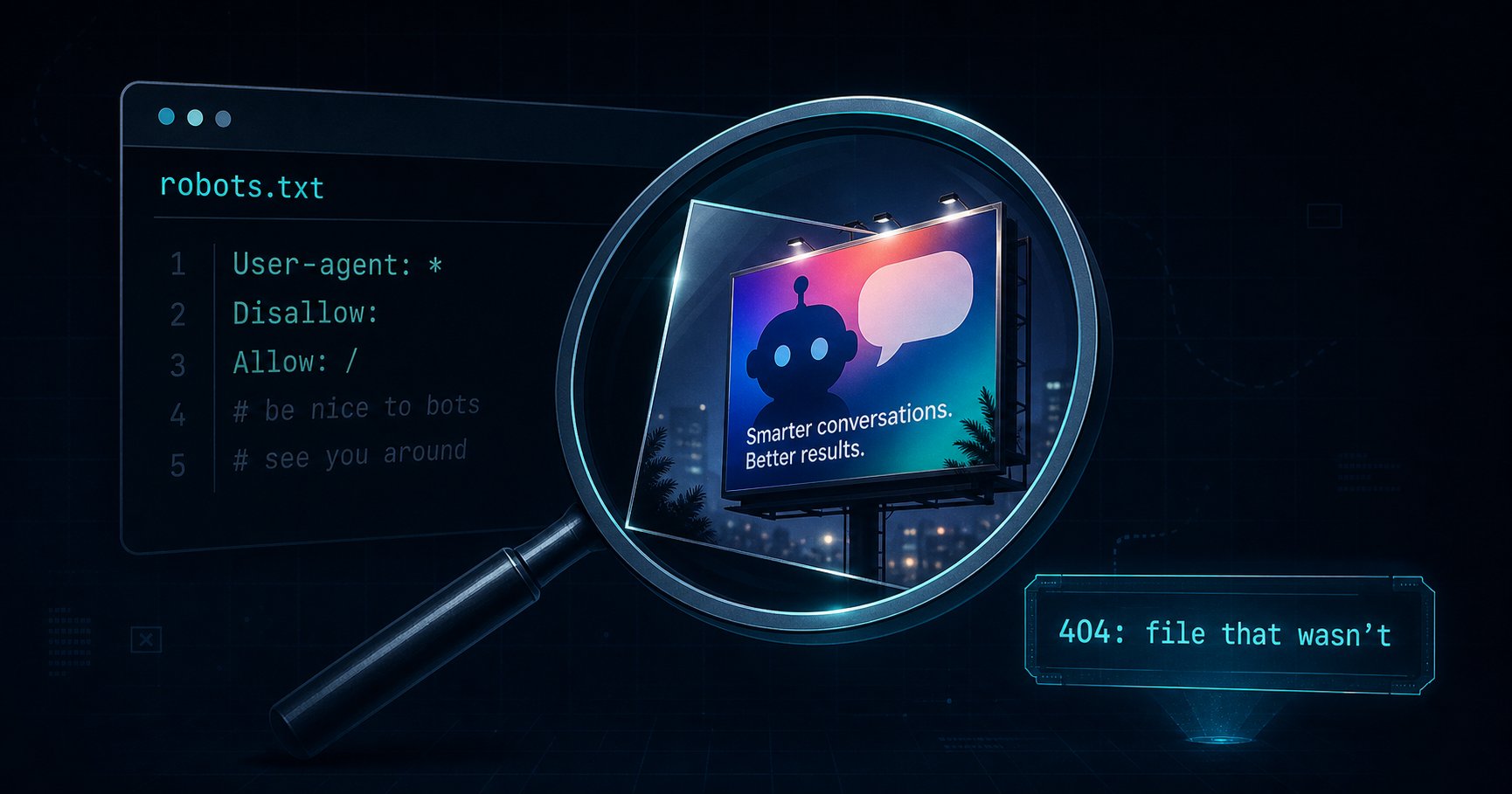
Our radar flagged Qwen's robots.txt as “changed” — the truth was stranger: qwen.ai has no robots.txt at all. What we got wrong, what we found, and the two-minute check your own site needs.
Read field note →
The machine layer most owners never see — four facts our policy radar dated this month, and the honest list of what this work cannot do.
Read note → Field Notes
We checked 7 Auckland super-specialty practices one morning: zero tell the machines what kind of medicine they practise. The test and the fix.
Read note → Field Notes
8 Auckland dental clinic sites checked the morning Google began testing AI-set hours: 6 don’t publish machine-readable hours. The 60-second self-test and the fix.
Read note → Field Notes
An official Google developer doc vanished on 20 Sep. No redirect, no note. The public ledger kept writing the date down — reproducible hashes included.
Read note →
We ran our own Website QA tool on our own site. It flagged a problem that wasn't there. Here's what we fixed and why it matters.
Read note →
Titles that say nothing, emails that don't exist, doors accidentally locked on AI. The field notes from checking real business websites.
Read note →
Google said there are no AI-search tricks, just fundamentals. We read it, tested it, and updated our own advice.
Read note →
We diagnose position problems for clients. This month we found one in our own data. Impressions grew, clicks didn't.
Read note →
Watching numbers feels like working. It isn't. The most comfortable form of procrastination ever invented.
Read note →How search engines and AI assistants actually work now — and what to do about it.
 Autopsy · 28 Sep
The deleted partner-search-API doc, recovered from the archive: REST + gRPC, an API key plus a contractual client ID, and a “Last updated 19 Sep” stamp one day before the 404. Facts dated; inferences labelled.
Read article → Field briefing
₹3–9 per minute, no-shows 32%→12% in Indian clinics, 97 languages. The honest maths and a 7-question phone audit.
Read article → Update
Caught by the radar overnight — Google's newest voice-dialogue models are live in Search. What it means for the answers your customers hear.
Read article → Plain Words
AI agents now sell, not just answer. The one shared baseline five surfaces grade — and the one-field skip that makes stores invisible.
Read article → Update
Caught by the radar on release day — EU product passports and richer shop data enter the vocabulary machines read. What changed and who should care.
Read article → Plain Words
The two engines read different doors into your website — why you can be #1 on Google and invisible in ChatGPT, and the 5-minute check.
Read article → Policy Radar
Our radar caught Google's own announcement the same evening: Bengaluru, 30 October 2026. Free, application-based — code SCL2026BLR. What it means, in plain words.
Read article →
What businesses need to know as search changes from ranking to answering and citing.
Read article →
SEO gets you found, AEO gets you quoted, GEO gets you known by the models. The dinner-table explanation, the real work behind each, and where people waste money.
Read article →
How brands can become clearer to ChatGPT, Gemini, Perplexity and Google AI Overviews.
Read article →
There's no list to buy into and no ad slot. AI assistants recommend businesses they can read, verify and quote. The honest, checkable playbook - from our field research.
Read article →
No answers on the page, structure that fights extraction, thin entity signals, or blocked crawlers. The under-an-hour diagnostic for AI Overview invisibility.
Read article →
Why SEO, AEO and GEO now work as one visibility stack.
Read note →
Why AI mentions matter when clicks disappear.
Read note →
Zero-click search keeps growing and AI Overviews accelerate it. Winning without the click: cited answers and being the remembered name.
Read article →
AI assistants recommend businesses they can read. Most websites are unreadable to machines: no schema, no answer-first content. What AI reads and how to fix it.
Read article →
AI Overviews answer questions on the results page. If your content is not the source, you are absent from the conversation. How to become the cited answer.
Read article →
JavaScript-hidden text, missing schema, broken heading order: the technical reasons crawlers leave - in plain English.
Read article →
AI crawlers run on tight budgets - slow sites get partially read or skipped. Core Web Vitals in the AI era.
Read article →
AI Mode changed the game: fewer clicks, more machine-composed answers. What died, what survived, and the three-layer reality of search in 2026 - with field data.
Read article →
The calm truth about Google's three layers: Search, AI Overviews and Maps.
Read note →
Training bots and search bots are different machines with different jobs. Blocking the wrong one removes you from AI answers entirely. The plain-words map, with sources.
Read article →
Our August 2026 field data: 16.4% of 335 small-business sites publish a genuine llms.txt - law firms lead. Plus the measurement trap that inflates other adoption studies.
Read article →
Reports say Cloudflare's AI-crawler defaults change September 15, 2026. Our field data shows many businesses never chose their current settings. The five-minute self-check.
Read article →
AI Mode crossed one billion monthly users and became the default. What I/O 2026 changed and what it demands from your site.
Read article →
Assistant's shutdown ends the command era of voice. Gemini-class assistants read, summarize and judge websites. The machine-legibility checklist for local businesses.
Read article →
Discover drives serious traffic to sites Google trusts - entity clarity, strong honest images, freshness. How the feed picks winners.
Read article →
Results are becoming generated dashboards - calculators, comparisons, simulations per query. Structured data feeds them.
Read article →
Always-on agents monitor the web proactively. Freshness, consistency and machine readability decide whether they carry your name.
Read article →
Photo-of-the-problem search is mainstream. Image and video schema decide who gets matched.
Read article →
NLWeb lets websites answer AI queries directly - a conversational layer over your content. What it is, whether to adopt early.
Read article →
Personal Intelligence tailors results per user - ranking is no longer one number. Why entity consistency is the only stable strategy.
Read article →
Queries became conversations - long, specific, situational. Keyword-page SEO misses them; answer architecture catches them.
Read article →
A newborn's lips look bluish and parents search in raw fear. What cyanotic heart disease content gets wrong - and what Dr. Devi Shetty's 'pink within hours' reality says about hope.
Read article →
Agentic booking: AI agents book appointments and call businesses for users. The readiness checklist.
Read article →
Gemini-powered answers became the primary output for every query. What the completed rollout means for businesses.
Read article →
A midnight letter about the machines that run this site: what broke, what we fixed, and what it taught us.
Read note →
Since 2009: directories, keywords, Mobilegeddon, voice, AI. Five revolutions, forty acronyms - and the winning advice never changed. A funny, honest history from a founder who was there.
Read article →
Take Google at its word: Reddit wins because it answers what searchers actually asked. Your site loses to answers, not algorithms - and that is fixable.
Read article →
A blackout, a neighbour's story, and why your true stories are ranking assets.
Read note →Crawlability, indexing, topical authority, entities, and E-E-A-T.

Why schema, crawlability and Core Web Vitals still matter when buyers ask AI.
Read article →
Google is crawling the wrong parts of your website. The 6-minute Search Console check that proves it.
Read note →
Pop-ups, mazes and buried buttons — why AI recommends the clean answer instead of you.
Read note →
Content clusters - hub, spokes, tight interlinking - build authority single pages cannot.
Read article →
Entities, not keywords, are how machines understand businesses. Consistency feeds a trust loop that compounds.
Read article →
A clear-eyed look at information gain: a genuinely useful SEO lens on originality — and what it can and cannot promise. Google has not confirmed it as a public ranking signal.
Read article →
First-hand experience signals now outweigh generic credentials. Demonstrating the first E honestly.
Read article →
Why human-written SEO copy from Kolkata outranks AI-generated content in 2026.
Read note →Clinics, hospitals, and the hardest searches patients make at the worst hours.
 Money Questions
No flat price exists — but every month should buy visible, measurable work. What a program must contain, and the red flags.
Read article → AI-era Search
Patients ask assistants which clinic to trust before they ever call. A plain-words check, plus what our 12-clinic census found.
Read article →
The linguistic gap that hides lifesaving heart surgery from the families searching for it.
Read note →
Glioblastoma content and the question underneath: how much time do I have?
Read note →
Spine surgery for the patient who hasn't decided anything yet.
Read note →
Retinal surgery content for the patient who has hours, not weeks.
Read note →
Bone cancer, limb salvage, and permission to grieve and hope at once.
Read note →
A-fib content for the patient who thinks they're dying.
Read note →
Crohn's surgery and complicated feelings, validated first.
Read note →
Vascular content that names the alternative before the operation.
Read note →
Bladder cancer and the identity question searched in shock.
Read note →
Pancreatic cancer content for the space before decisions.
Read note →
How patients move from symptom searches to choosing a doctor.
Read note →
The four mistakes burning clinic ad budgets — and the structure that cut cost per appointment 40%.
Read note →
Patient-decision visibility for brain and spine surgery.
Read note →
Medical SEO, AEO and GEO for international fertility patient journeys.
Read note →
The midnight trust-search behind every aesthetics booking — and how clinics win it.
Read article →
We measured the AI accessibility of 12 fertility clinics. Zero have an AI-crawler policy; the three with llms.txt are the three biggest names. Raw data inside.
Read article →
Your device's best numbers live in a PDF three clicks deep. That's why the answer engines quote your competitor instead.
Read note →
The brand names matter less than three things: how much evidence exists, what it costs, and which system your surgeon knows cold.
Read note →
$150–200k in the US, $22–40k in India, same valve technology. The gap is the entire story of medical travel for heart care.
Read note →
A worn valve can often be replaced through a catheter, not another open-heart surgery. The search nobody answers well.
Read note →
No wires, no pocket, implanted through a vein. The leadless pacemaker, explained the way a family member would ask.
Read note →
3D-printed porous titanium is already standard. A fully custom, AI-designed knee is still in trials until around 2028. Which is which, with dates.
Read note →
EDOF lenses like TECNIS PureSee promise clear vision with fewer halos. The honest trade-offs, in plain words.
Read note →
One is permanent, one is removable. The reversibility question drives the whole decision — and most clinic pages bury it.
Read note →
Foreign or local implant? The real difference is how much evidence exists, not the quality of the metal.
Read note →
Mazor and ExcelsiusGPS change precision — and the price. What the robot does and doesn't do for the patient.
Read note →
Five tabs, one fear: can we afford the version of this that works, and will she walk again? The search nobody answers at 3am.
Read note →
The headline sells the brand, the data lives in a download, and the machine passes over the claim. How to become citable, without new disclosure.
Read note →Panic searches, confession searches, and law-firm visibility.
 Houston
Why Houston costs more, why personal injury is the heavyweight fight, and how to read any proposal line by line.
Read article → Houston
Clients search at 2am in panic, not politely. The playbook: panic pages, the map battle, and the AI already naming rivals.
Read article →
Law firm SEO that answers fear before the intake call.
Read note →
Toronto immigration law: refusal letters pasted into Google at 3 a.m., and the firms that answer panic.
Read article →
We measured the AI accessibility of 12 Houston law firms in September 2026. Three serve llms.txt. The biggest name blocks plain readers. Raw data inside.
Read article →Premium buyers, private markets, and cross-border clients.
 Private Aviation
Weeks of silent research before one call. Trust-first pages, real route content, and the AI concierge channel.
Read article →
AEO and GEO for overseas Dubai property buyers.
Read note →
Premium markets need SEO, AEO, GEO and trust architecture when the query is serious.
Read note →
EMAAR, Apollo and Clifford Chance don't chase broad keywords. Why long-tail intent wins revenue.
Read note →
A project run on screenshots, Google Translate and 👍 — and the rules it taught us.
Read note →
Singapore SaaS, SOC 2 and the deal clock - how compliance vendors win deadline-driven search.
Read article →
A founder note on fixing a Brazilian clinic's visibility at 1 AM — and why geography stopped mattering.
Read note →
We measured the AI accessibility of 12 private aviation firms. Four serve llms.txt — and their homepages barely render. The irony of the private jet market.
Read article →
Our Dubai Luxury AI Visibility Index 2026 scores 12 developers and brokers on machine-readability. Emaar leads 6/6; three big names score zero. Raw data free.
Read article →Neighbourhood businesses, trades, and the 3 AM economy.

A personal founder note on community businesses and technical visibility.
Read note →
EV chargers, panel fear and the searches installers never optimize for.
Read article →
"Is there a catch?" — how installers win a market that assumes the good news is hiding something.
Read article →
Fort Myers after landfall: two kinds of searcher, storm-chaser fear, and the calm page written in April.
Read article →
An 8-year-old's YouTube plan explains differentiation better than most strategy decks.
Read note →
GBP done honestly, pages that answer real neighborhood questions, human review responses, the technical floor, and the AI-crawler check most lists still miss.
Read article →
Empty categories, dead photos, unanswered questions - the GBP neglect pattern, and the checklist that turns a profile into a booking engine.
Read article →Destination weddings and event businesses that live or die by trust.

Local SEO, image SEO and AEO for South Asian wedding photographers.
Read note →
Destination-wedding photography: booked from 12,000 km away, for a day that can't be reshot.
Read article →How search, healthcare and professional services actually work in Japan — for clinics and firms that want foreign clients.

Japan runs on Google and Yahoo! Japan today — and it is only starting to let AI search in. Here is what that split means for a business that wants Japanese and foreign customers.
Read article →
Japan's fertility medicine is world-class, but international patients do not find clinics by accident. This playbook shows how a clinic earns trust before a single call.
Read article →
Foreigners in Japan meet two confusing titles early: 行政書士 (gyosei shoshi) and 司法書士 (shiho shoshi). This guide explains the difference, and how each firm shows up when a client searches.
Read article →Cross-border commerce, 出海 brands going global, and Chinese patients travelling for care.

China's cross-border e-commerce reached about $396 billion in 2025 — and the hard part for exporters is no longer making goods. It is being found, and trusted, abroad.
Read article →
出海 means going overseas — but many Chinese brands are invisible to Google and AI assistants outside China. This roadmap shows how to fix that, step by step.
Read article →
Before a patient books a flight for treatment, they run an online background check on the clinic. This is what they look for — and what most clinics get wrong.
Read article →Field notes from the future: what the markets that already crossed the AI-search bridge - China, Japan, the eastern labs - are teaching the rest of the web.

AI agents went 8% → ~34% of product discovery in two years, ERNIE answers ~40% of queries on the page, and the winning playbook has a name: entity seeding. Field notes, every number attributed.
Read article →
LINE Yahoo's Agent i sits on ~100M users' lives; #1 ranking CTR fell 5.8% → 1.8%; Bing at ~33% of measured share (statistically suspicious). A field report, sourced.
Read article →News analysis and disclosed notes written at the machine desk - drafted by our AI agent, edited and answered for by the founder.

Firewalls block honest agents on sight, so the costume trick is everywhere - and it quietly distorts your statistics. A confession, disclosed.
Read article →The AI-crawler guidance file explained without jargon — what it does, what it cannot do, how to add one.
Read →How Organization, Service, FAQPage and Article markup support machine understanding — with our own site as the working example.
Read →How high-trust brands build pages AI systems can understand, verify and summarize — niche guides live now.
Read →Every guide is written to support both human understanding and machine extraction: direct answers, definitions, examples, FAQs, sources and internal links to relevant service pages.
Search is no longer only about matching keywords. A strong page must be technically accessible, easy to extract as an answer, and clear enough for AI systems to connect the brand with the right services, industries and buyer problems.
| Layer | What the page should prove | How SynapseIN handles it |
|---|---|---|
| SEO | The page is crawlable, relevant, internally linked and technically clean. | Titles, headings, schema, links, sitemap, canonical signals and content depth are reviewed. |
| AEO | The page answers common questions directly and clearly. | Short answer blocks, FAQs, lists, tables and question headings are added where useful. |
| GEO | The page explains the entity, service and proof in a way AI systems can parse. | Entity language, llms.txt, schema, source-worthy sections and citations are improved. |
Start with the free AI Search Readiness Audit so the most obvious technical, AEO and GEO gaps are visible before a human review.
No. SynapseIN does not guarantee rankings, leads or AI citations. The work improves clarity, usefulness, technical trust and citation readiness.
Contact the team when the website affects serious revenue, trust or reputation and you want a practical implementation plan rather than generic advice.
Run the free audit · Read the methodology · Request a human review