The 240-question form that ruins a founder's evening.
B2B compliance searches happen on a deadline someone else set. The vendor who answers with numbers instead of journeys gets the demo - and the AI citation.

A story from the SynapseIN desk. The businesses here are composite scenarios - invented to teach. The search behavior, psychology and mechanics are real.
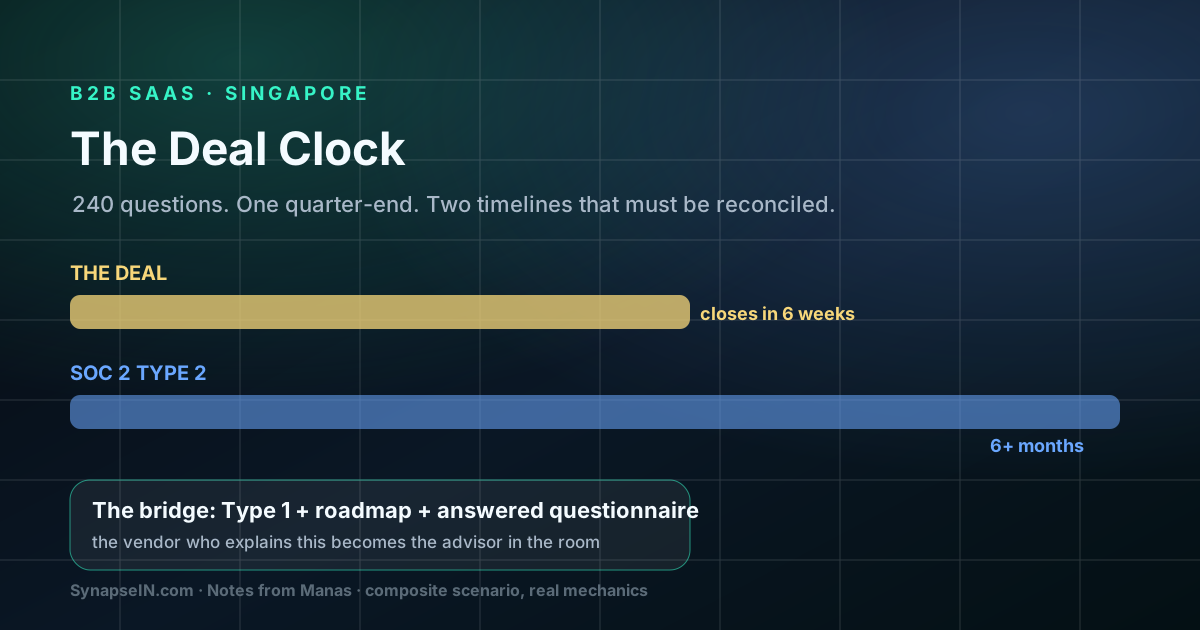
Picture a two-year-old fintech startup in Singapore. Eleven people, real product, first enterprise deal on the table. Then the buyer's procurement team sends the vendor security questionnaire: 240 questions, and question one is "Are you SOC 2 certified?"
That evening, the founder's searches look like this:
Look at the shape of these. This is not curiosity - this is a deal clock ticking. Somewhere a procurement officer is waiting, a quarter is ending, and a founder is discovering an entire industry of auditors, platforms and consultants - all of whom seem to speak in acronyms and "contact us for pricing."
What the typical compliance vendor website says
"Automate your compliance journey. Trusted by 5,000+ companies. Book a demo." Pricing hidden. Timelines vague. Every page written as if the reader already knows what a Type 2 observation window is.
The Singapore founder does not want a compliance journey. He wants to know three numbers: how long, how much, and whether the deal survives the wait. The vendor who states those numbers plainly gets the demo call - and everyone else gets compared to that vendor's numbers anyway.
What the deal-clock version looks like
- The "can you close the deal first" page: the honest answer many vendors will not publish - buyers often accept a signed agreement plus a compliance roadmap in progress. Explaining bridge options (questionnaire answers, policies, a Type 1 first) can save the deal, and the vendor who explains it becomes the advisor in the room.
- Real timelines with stages: what happens in weeks 1-4, what the observation window means, why Type 2 cannot be rushed - dates a founder can put in front of a procurement team.
- Cost ranges with the levers visible: what moves the price - scope, number of systems, readiness - so a founder can budget before the sales call instead of after three of them.
- Machine layer: FAQ schema on the exact panic questions, comparison content structured in clean chunks, and terminology explained inline - because when a founder asks an AI assistant "type 1 vs type 2 for enterprise deal", the vendor whose explanation is cleanest becomes the citation.
The psychology, plainly
B2B compliance buyers are not evaluating software the first night - they are trying to make a deadline survivable. Fear of losing the deal, embarrassment at not knowing the acronyms, suspicion of hidden pricing: whoever dissolves those three feelings owns the shortlist. In deal-clock markets, transparency is not a virtue. It is the growth channel.
Questions people actually ask
Can a startup close an enterprise deal before SOC 2 is complete?
Often yes - many enterprise buyers accept a signed security questionnaire, documented policies and a credible in-progress compliance roadmap, sometimes with a Type 1 report as an interim step. It depends on the buyer's risk team, which is why compliance vendors who explain bridge strategies openly win founder trust at exactly the highest-stakes moment.
What is the realistic difference between SOC 2 Type 1 and Type 2?
Type 1 assesses controls at a point in time and can be reached relatively quickly; Type 2 requires an observation window of several months proving controls operate over time. Enterprise buyers increasingly want Type 2 - but Type 1 plus a roadmap frequently carries a first deal.
Why does transparent pricing matter so much in compliance markets?
Because the buyer is a founder under deadline pressure comparing unknown costs against a known deal value. Vendors who publish ranges and the levers behind them get budgeted into the decision early - and get quoted by AI assistants when founders ask what compliance should cost.
Is your market's 2 a.m. question answered by you - or a competitor?
Run the free audit to see how machine-readable your site is today. If the gaps run deeper than technology - into what your pages say and don't say - that's a human conversation.