Four times more sites block AI crawlers than robots.txt admits
We asked 170 websites for their homepage twice. Once as an ordinary browser, once as GPTBot, from the same IP address. Twenty-three refused the AI crawler. Five had said anything about it in robots.txt.
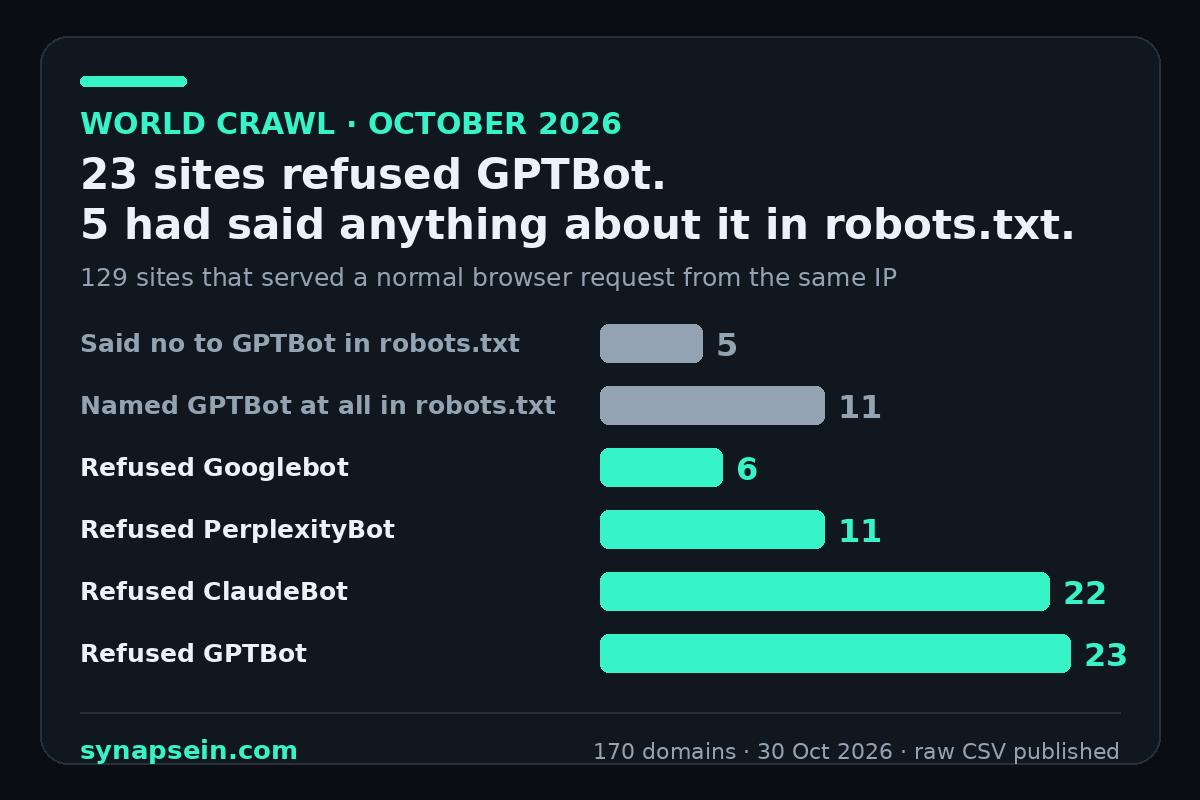
Here is the argument in one sentence. Every article about AI crawler policy reads robots.txt. Almost none of them check whether the server obeys it.
Method, and why the browser request is there
On 30 October 2026 we took a panel of 170 domains across the sectors we already audit: surgical instruments and medical devices, industrial equipment, caster and packaging manufacturers, yacht brokerages, clinics, plus the largest device companies and the search engines themselves. For each domain we recorded four things.
First, its robots.txt, fetched as a browser, parsed for whether GPTBot appears and whether it is disallowed from the root. Second, a request for the homepage with a normal Chrome user agent. Third, the same homepage from the same IP address with the documented GPTBot user agent. Fourth, the same again as ClaudeBot, PerplexityBot and Googlebot.
The Chrome request is the whole method. Our servers sit in a data centre, and plenty of firewalls refuse data centre IPs regardless of name. If we had only sent the GPTBot user agent, every refusal could be explained by our IP address and the study would be worthless. Because Chrome is served and GPTBot is refused from the same address in the same minute, the refusal can fairly be attributed to the declared identity. Sixteen of those refusals were 403, six were 429 rate limits, one was 412.
129 of the 170 domains served the Chrome request properly, which is our usable sample. 33 were unreachable from our network and are reported as such rather than counted as blockers. The full file, status codes and all, is on the CSV.
Independent check: the headline rows and both edge cases were re-run the same day from a separate, independent bench (a different network and codebase): every refusal count, the Yahoo Japan contradiction, and the eight-domain reversal all reproduced. The evidence pack is kept in the in-house ledger.
Results
Of the 129 sites that served a browser:
GPTBot was refused by 23 sites, 17.8 percent. ClaudeBot by 22, 17.1 percent. PerplexityBot by 11, 8.5 percent. Googlebot by 6, 4.7 percent.
Now the comparison that made us re-run the panel to be sure. Across all 170 domains, 11 name GPTBot anywhere in robots.txt and only 5 disallow it. So the published policy of this panel covers five sites that say no. The actual behaviour of the same panel refuses 23. Blocking is four times more common in practice than in the paperwork.
That number is the story. The rest is detail.
The silent blockers
Eighteen of the 129, about one in seven, refused the GPTBot request while their robots.txt contained no mention of GPTBot at all. Not an allow rule, not a disallow rule, nothing. The decision was made somewhere else entirely.
In most of these cases the fingerprint points at the edge rather than the origin. A 403 delivered instantly, before any page rendering, is a firewall or CDN verdict. The pattern matters commercially because these settings are usually one toggle in a hosting dashboard, applied months ago by someone who has since left, and never mentioned to the person who owns the marketing budget. The company believes it is open to AI search. Its hosting provider decided otherwise, and nobody told the owner.
We are not naming these eighteen in public, because a small company cannot answer a public accusation and we do not punch down. If your site is one of them you already have the CSV, and our inbox is open.
The opposite error, and why it matters
One site in the panel does the opposite, and it is a large one. Yahoo Japan publishes a robots.txt that disallows GPTBot and Google-Extended from the root, both by name, in public. We asked it for the homepage as GPTBot, and it served us 152,114 bytes of HTML without complaint.
That is not hypocrisy, it is how the protocol works. robots.txt is a request from the site to the crawler, and enforcement lives with the crawler. A site that disallows in robots.txt and serves anyway is relying entirely on the crawler's good manners. Which is fine, and honest, and the opposite of the eighteen silent blockers whose policy exists but is nowhere written down.
Both errors appear in the same panel on the same day. One is policy without enforcement. The other is enforcement without policy. Only the second is common.
What the welcoming door sees
For contrast, from a site whose policy says yes: over September 2026 our own guestbook counted 2,514 visits from GPTBot, plus 803 from OAI-SearchBot and ChatGPT-User - every one served, none challenged (full census here, with its own CSV). That is what the 17.8% up top are missing, and what the others quietly gain.
ClaudeBot is refused more often than GPTBot
Eight sites in the sample served GPTBot and refused ClaudeBot, including small manufacturers and one orthopaedic implant maker. The reverse asymmetry barely exists. We can see the pattern and we cannot fully explain the cause from outside, but the likely mechanism is allowlists: a CDN configured to permit the best known crawlers by name may have GPTBot and Googlebot in its defaults and ClaudeBot missing, or ClaudeBot arriving unverified against a published IP range that the operator never added.
Either way, the practical consequence is odd and worth saying plainly. A site can be readable by ChatGPT and invisible to Claude for reasons nobody at the company chose.
What this study cannot tell you
We sent the user agent strings ourselves, so this is not evidence of what the real crawlers experienced at any other hour. A site may block unverified declarations of GPTBot, which is arguably correct security, while allowing the genuine crawler after IP verification. That is a reasonable defence and we are not calling it a lie.
Our panel is deliberate, not random. It reflects trades we audit, so it over-represents small industrial and medical companies and is not a sample of the whole web. The numbers describe this panel on this day and nothing more.
And the honest one. Being refused in this test is not proof of lost business. It is proof that a decision exists which nobody wrote down.
What officially moved while we measured
The week of this crawl was not a quiet one at the standards desks:
- 29 October 2026 - Google re-dated all four crawler IP files the same day: common crawlers 317 prefixes, special crawlers 272, user-triggered fetchers 1,068, agents 20 (file dates are public). Any firewall allowlist older than last night is stale.
- 29 October 2026 - the IETF webbotauth working group published draft-ietf-webbotauth-httpsig-protocol-01, the standard-in-progress for cryptographically signed bot requests (tracker). Google-Agent already signs at agent.bot.goog; GPTBot does not yet. Verification is moving from "trust my name" to "check my signature."
- 2026 mid-year UA drift, still settling: Google renamed Google-NotebookLM to Google-GeminiNotebook, and OpenAI's docs now carry four bots including OAI-AdsBot. Verification by user-agent string alone needs an annual re-check - which is exactly why the second half of this study (from our server logs, next month) matters.
- One honest caveat for this page: a refusal can come from stale memory, not intent - a 403 served because a 2025 allowlist never met a 2026 IP. Policy you cannot verify is not policy.
- 30 October 2026 - the big AI companies agreed on one robots.txt line. Google, Microsoft, OpenAI and Anthropic all backed a shared policy token,
__usage_ai-training, from an IETF draft written by Anthropic's Kevin Kelley (the draft). One group in robots.txt now states a training preference for every provider that honours it. Three things in the draft matter: it is a use preference, not a crawl block; a wildcardUser-Agent: *group does not count as expressing one; and a file with no such group has expressed no preference at all. - 30 October 2026 - Microsoft split training from grounding. Bing now takes a page-level AI Grounding preference (Allow by default, DisallowExtended, Disallow), separately from training. A publisher can refuse model training and still let Copilot cite the page - impossible the day before. Their transition dates: temporary controls open 15 December 2026, the preferences are honoured from 1 February 2027, and NoArchive and NoCache stop being read as AI preferences on 1 March 2027.
- 30 October 2026 - Google said how it will read the token. Opt out with the shared token and Google plans to treat it as a disallow of Google-Extended, aiming for early 2027. Google-Extended stays outside Search ranking, and a site that explicitly allows it remains eligible for grounding and clicks in Gemini Apps.
- Why this matters for the 170 sites above. 18 of them refuse AI crawlers while their robots.txt says yes. From 2027, saying no once, in writing, becomes easy and portable - so the silent refusal gets harder to defend and easier to audit. Intent becomes a thing you can file.
What to do about it
Decide once, enforce in one place, and write it down. If you want AI crawlers in, verify them by published IP ranges rather than by name, because names are free to fake and ranges are not. Google republished its own ranges on 29 October, 317 prefixes for Googlebot, 272 for special crawlers and 1,068 for user triggered fetchers, so any allowlist older than that is already stale.
If you want them out, say so in robots.txt as well as at the edge, so the decision is documented, dated and reversible by whoever comes after you. A silent refusal at a CDN is a strategy nobody can audit.
Then run the same test we ran. Ask your own site for its homepage as a browser, then as GPTBot, from outside your office network, and compare. Our free checkers are on the tools page, and the explanation of what these files do is on what GEO actually means.
Questions people actually ask
What did this study measure?
On 30 October 2026 we took 170 domains and did three things with each one. We read its robots.txt. We requested its homepage with a normal Chrome browser user agent from our own server. Then we requested the same homepage from the same IP address with the user agent of GPTBot, then ClaudeBot, then PerplexityBot, then Googlebot. The Chrome request is the control: it separates a site refusing because of the declared crawler name from a site refusing our data centre IP outright.
How many sites block AI crawlers in practice?
Of the 129 sites that served the normal browser request, 23 refused the GPTBot request, which is 17.8 percent. 22 refused ClaudeBot, 11 refused PerplexityBot, and 6 refused Googlebot. Only 11 of the full 170 name GPTBot anywhere in robots.txt and only 5 disallow it.
Why is there a gap between robots.txt and what the server does?
Because robots.txt is a voluntary request with no enforcement mechanism. A site can disallow GPTBot in robots.txt and still hand over the page, which one large Japanese portal did. The reverse also happens and is far more common: a site never mentions AI crawlers in robots.txt, but its firewall or CDN refuses the request anyway. Blocking has moved from the file to the edge, and the file was never updated.
Does this prove these are the real OpenAI or Anthropic crawlers?
No, and we will not pretend otherwise. We sent the documented user agent strings ourselves. This measures what a server does with a declared identity, not what the real crawler does in the wild. That limitation is the entire reason the browser control exists in the method.
What should a site owner do about it?
Decide once, then enforce in one place. If you welcome AI crawlers, make sure your CDN and firewall allowlist them by verified IP ranges rather than user agent, and keep robots.txt honest about it. If you refuse them, say so in robots.txt so the decision is documented and reversible. A silent refusal at the edge is a business decision nobody in the company knows was made.
Where is the raw data?
The full panel is published as a CSV with one row per domain, including every HTTP status code, response size and timestamp, so anyone can re-run or dispute any row.
Full data: world-crawl-2026-10.csv, CC BY 4.0, no permission needed to reuse it with attribution. Method questions and disputes: message us and we will re-run any row with you. Corrections go on the glass page the same day. This is entry one of a monthly series, and next month's panel includes the same domains so the changes are visible.
A closer look at your own site
For a scoped human review of search and AI visibility, see our AI visibility audit service. A technical test does not prove what a real crawler experienced.