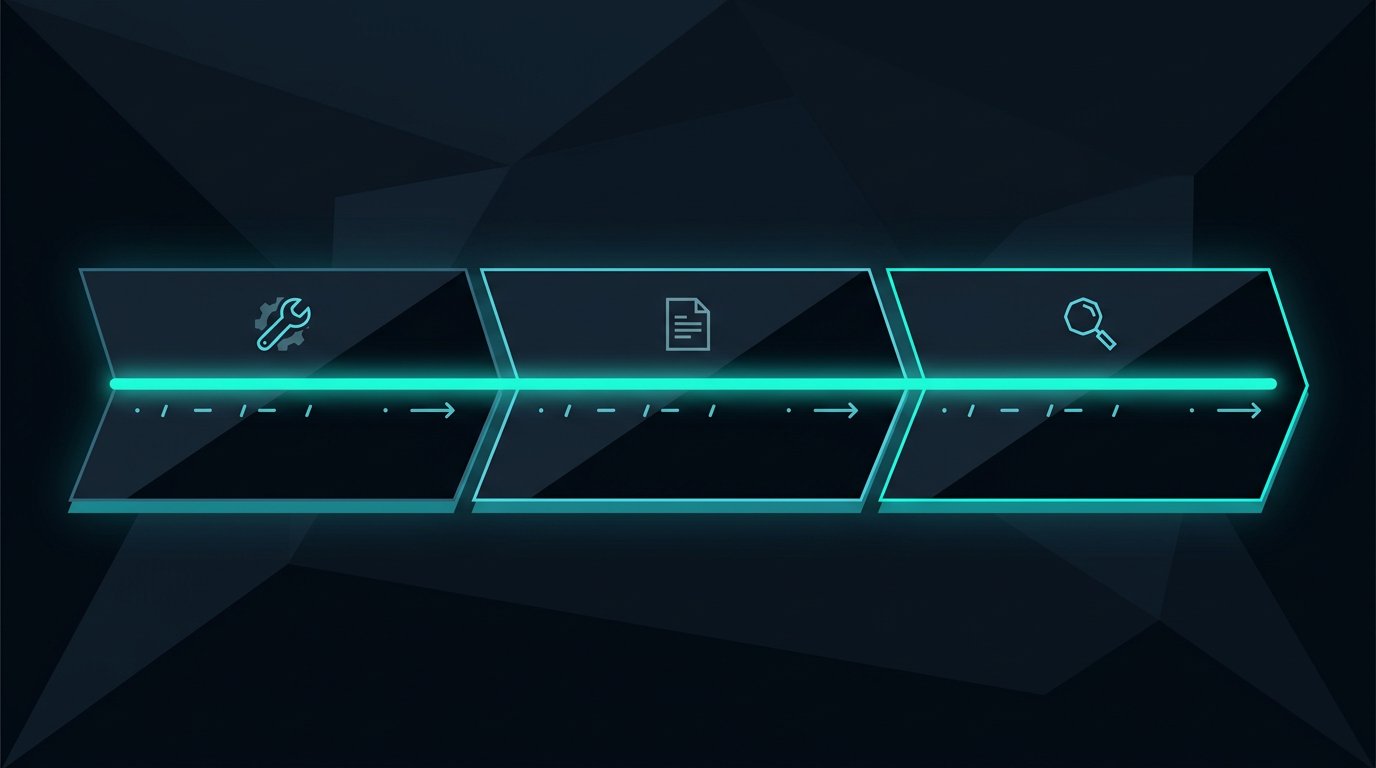
Short answer: Month one is access, baselines and diagnosis. Month two is prioritised fixes and the first content or structure work, with your team implementing the technical items. Month three is proof: what changed, what moved, what didn't, and a revised plan. If nobody can show you a list of changes made and evidence behind them by day 90, the engagement is drifting.
Days 1–14: Access, baselines, and listening
Boring, and non-negotiable. Before any tactic, the agency should:
- Take read-only access. Search Console, analytics, and any ad or profile accounts. Read-only first — Google's guidance to businesses is explicit that audits need read access, not write access (2). If someone insists on write access on day one without a specific reason, ask why.
- Record the baseline. Current impressions, clicks, indexed pages, top landing pages, enquiry volumes, and a dated snapshot of how AI assistants describe you. Baselines taken later are reconstructions, not evidence.
- Interview the humans. Who buys, what they ask before they buy, what the sales team hears on calls, what the last three lost deals had in common. Programme managers call this discovery. It is really just good manners plus listening.
Checkpoint at day 14: you should have seen a written baseline and a first issue list with URLs attached. If the first two weeks produced a brand audit deck with no URLs in it, say so early.
Days 15–45: Diagnosis becomes decisions
This is where most engagements either sharpen or sag. The agency should now turn findings into a short, ranked list — not 200 tickets.
A good priority list answers: what is costing us the most, what is cheapest to fix first, and what needs a decision from the business rather than a developer. Typical month-two outputs:
- Technical priorities with exact pages: indexation gaps, redirect chains, canonical conflicts, broken internal links, mobile problems, template-level schema errors.
- Content priorities: the five or ten pages closest to commercial intent, what each is missing, and which need rewriting rather than more pages.
- Quick wins folded in early: title and snippet improvements on pages that already rank, internal links to pages that deserve them.
- A shared decision log: what was chosen, what was rejected, and why. This single document prevents most month-four arguments.
Checkpoint at day 45: you should be able to read the priority list and see your own business in it. If every recommendation could have been written for any company in your industry, it was.
Days 46–75: Execution, with owners named
Work now needs names against it — the agency's name or yours. A weekly or fortnightly rhythm helps: what was shipped, what is blocked, what needs sign-off.
Watch for these month-three realities:
- Technical fixes land in sprints. Your developer's queue is the real schedule, and pretending otherwise creates false expectations on both sides.
- Content takes longer than people think. Drafting, reviewing facts, legal or clinical checks where relevant, and publishing all take time. Realistic engagements plan for it.
- Monitoring is not progress. If the monthly report lists "monitoring" and "optimisation" as completed work, ask for what was changed, where, and the reasoning.
Checkpoint around day 75: a change log you can audit. Every modification should be findable on your own site, with the date and the reason.
Days 76–90: An honest review
The day-90 review should answer four questions in plain language:
1. What did we change? The log, summarised.
2. What moved? Search Console trends, and any dated AI citation snapshots. Early movement may be modest; flat is also information.
3. What didn't move, and what is our new hypothesis? This is the most valuable slide in the deck. Agencies that cannot present a negative finding cannot be trusted with a positive one.
4. What is the plan for the next 90 days, and what could change it?
Google notes that improvements can take months to be reflected, and that positions are never fixed or static (1, 3). A day-90 conversation that acknowledges this is a sign of competence, not weakness.
What should not happen in 90 days
- A guarantee of page-one positions or AI citations. Google says no one can guarantee a number one ranking, and AI inclusion isn't guaranteed either (2, 4).
- A sudden flood of purchased backlinks from sites nobody would read.
- A "content strategy" of forty AI-written pages published in three weeks without review.
- Charges for "reporting" that turn out to be an exported Search Console PDF with your own data in it.
Questions to keep in your pocket
- Who exactly does the work, and who do I contact when something breaks?
- Which of these recommendations will my team have to implement, and what does that need from us?
- What will you do if the first 90 days show no movement at all?
- What would make you tell me this engagement isn't working?
The last question is the one worth watching their face for.
FAQ
Should SEO show results in 90 days?
Sometimes partial movement appears, especially from snippet or indexing fixes. Google's guidance points to months, sometimes a year, for fuller effects (1). A 90-day review should judge the quality of the work and the honesty of the plan, not only the traffic.
Is a 12-month contract reasonable?
Long contracts are common because the work compounds. What matters is scope, deliverables, reporting and exit terms in writing. If the contract protects only the agency, that tells you something.
What should month one look like if my site is brand new?
More of the same, minus the baseline data: technical setup, structure, first commercial pages, indexing checks. Expect longer timelines for competitive terms.
Who should implement technical fixes?
Usually your developers, but with the agency providing exact, prioritised instructions. Implementation included is fine too — just confirm which model you bought.
Sources
1. Google Search Central, SEO Starter Guide: "How long until I see impact in search results?". https://developers.google.com/search/docs/fundamentals/seo-starter-guide
2. Google Search Central, "Do you need an SEO?". https://developers.google.com/search/docs/fundamentals/do-i-need-seo
3. Google Search Central, "Do you need an SEO?" (results timing and guarantees). https://developers.google.com/search/docs/fundamentals/do-i-need-seo
4. Google Search Central, "AI features and your website". https://developers.google.com/search/docs/appearance/ai-features
Related from SynapseIN:
- SEO, AEO and GEO services: https://www.synapsein.com/seo-aeo-geo.html
- What an SEO, AEO and GEO audit should include
- How to measure AI search visibility
- Run the free audit: https://www.synapsein.com/audit.html